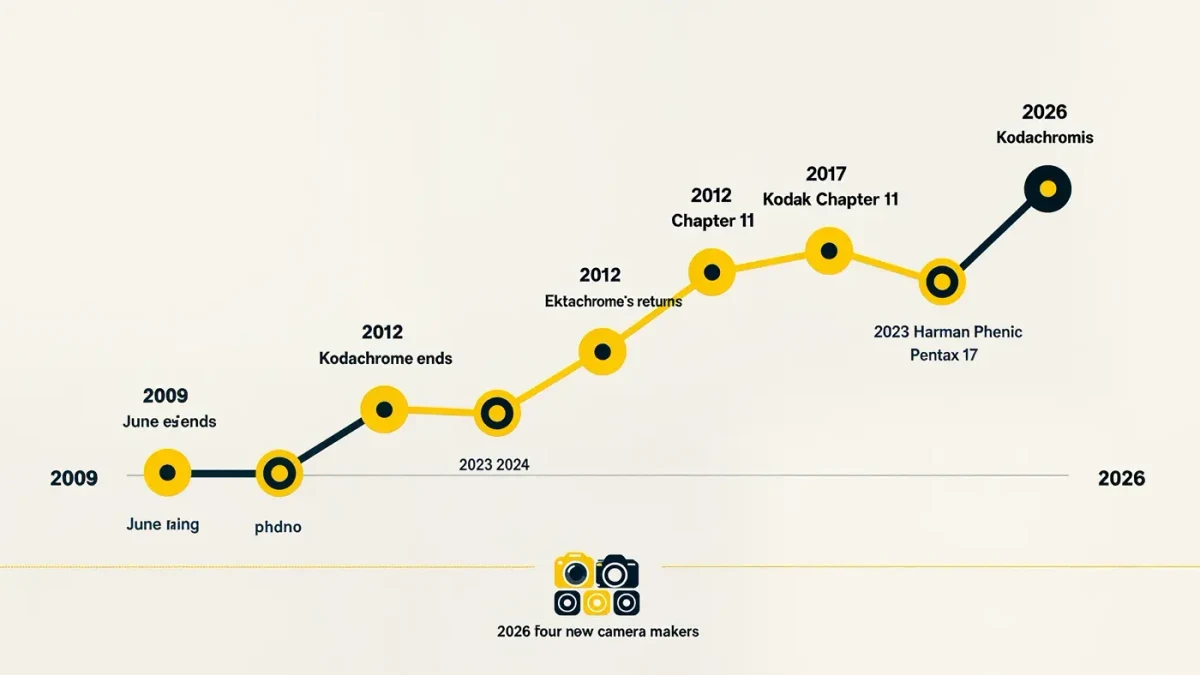
The film revival ran from obituary to production line in fifteen years. Kodak announced Kodachrome's retirement in June 2009; by early 2026, four makers were shipping new film cameras and Harman its fourth new color emulsion. Per the BBC on March 31, 2026, the film camera market — worth 223 million pounds in 2023 — is projected past 303 million by 2030.
When did film hit bottom?
The low years were 2008 through 2012, and they were brutal in sequence. Polaroid announced its exit from instant film in 2008; Kodak announced Kodachrome's end in June 2009, with the world's last processing line at Dwayne's Photo closing December 30, 2010; Eastman Kodak filed for Chapter 11 protection in January 2012. Each event was read as confirmation that digital had finished the format.
Yet the bottom is where the revival's first bets were placed. The Impossible Project, founded in 2008 after Polaroid's announcement, took over the last integral-instant factory in Enschede and shipped its first new instant film in 2010. Lomography kept selling film cameras and commissioning emulsions straight through the decade. Kodak Alaris, created in 2013 out of the Eastman Kodak pension settlement, kept stills film in worldwide distribution when nobody else wanted the job.
Who kept the lights on through the 2010s?
A short list: Ilford's maker Harman ran continuous production at Mobberley; Fujifilm kept a shrinking stills lineup alive while discontinuing wave after wave of professional stock through the decade's second half; Ferrania attempted an independent resurrection with a 2014 crowdfunding campaign; and Lomography built the LomoChrome family into proof that new film products could still sell out. The Impossible Project, rebranded back to Polaroid before the decade ended, made instant film a growth market again.
When did new product actually return?
January 2017 is the visible turn: Kodak announced Ektachrome's return at CES that month, with film shipping in 2018 — the first reversed discontinuation of the modern era. It mattered beyond one slide film because it told every other maker that demand had stopped falling. The BBC's March 31, 2026 report on the resurgence traces the same curve through younger shooters choosing film as a slower alternative to phone photography.
The 2020s then delivered the revival's boldest moves in a dense sequence — new cameras, new emulsions, and a distribution war, itemized below.
| Year | Milestone |
|---|---|
| 2008-2010 | Polaroid exits instant film; Impossible Project founded 2008, first new instant film ships 2010 |
| June 2009 | Kodak announces Kodachrome retirement; last processing December 30, 2010 |
| January 2012 | Eastman Kodak files for Chapter 11 protection |
| 2013 | Kodak Alaris formed to run stills film and photo business |
| 2014 | Film Ferrania crowdfunding bid to reopen an Italian coating plant |
| January 2017 | Kodak announces Ektachrome return at CES; film ships 2018 |
| 2018 | Fujifilm discontinues a wave of professional roll films |
| February 2021 | Fujifilm discontinues Pro 400H, the revival era's most-mourned stock |
| 2022 | Leica relaunches the M6; December: Ricoh unveils the Pentax Film Project |
| December 1, 2023 | Harman announces Phoenix 200, its first own-brand color film |
| June 2024 | Pentax 17 ships — first new Ricoh film camera in a generation |
| September 2024 | MiNT releases the autofocus Rollei 35AF |
| May-October 2025 | Kentmere Pan 200 (May 8), Phoenix II (July 16), LomoChrome Classicolor and the Lomo MC-A camera (October) |
| September-November 2025 | Eastman Kodak returns to direct US distribution, reviving Kodacolor, then Gold and UltraMax |
| Early 2026 | Alaris price round effective February 1; HARMAN Switch Azure 125 lands March 5; Lomography ships Classicolor in 110 |
What did the 2020s change that the 2010s did not?
Commitment. The 2010s revival ran on leftover capacity and heritage brands defending legacy products. The 2020s produced genuinely new machinery and emulsions: a purpose-built half-frame camera from Ricoh, an autofocus compact from Lomography at 549 dollars, Harman's color program expanding from one experimental stock to four, and Kodak's distribution arm wrestling its own shelf space back. Even the setbacks became informative — Fujifilm's March 2023 domestic supply suspension showed demand now outruns coating capacity, which is the opposite of the old problem.
Where does the revival stand as of 2026?
Alive, pricier, and structurally smaller than its peak but far bigger than its grave. Shooters in 2026 choose among multiple new cameras, a slowly growing list of new emulsions, and a used market that turned every closet SLR into currency. Fujifilm runs the counter-strategy: no new stills emulsions, an instax empire, slide film allocated like contraband. Both strategies are working, which is the revival's most confusing feature. The open questions are honest ones: whether Pentax's film project resumes after its reported pause, whether Analogue's aF-1 compact ships in its delayed Q3 2026 window, and whether price increases keep chasing new shooters away. What is no longer a question is the trend line. Film died on paper between 2009 and 2012, and every year since has been an argument, dated and shipping, that the paper was wrong.
For more context, read Who Makes New Film Cameras?.
For more context, read lomography news 2026.
For more context, read Why Film Keeps Selling Out.