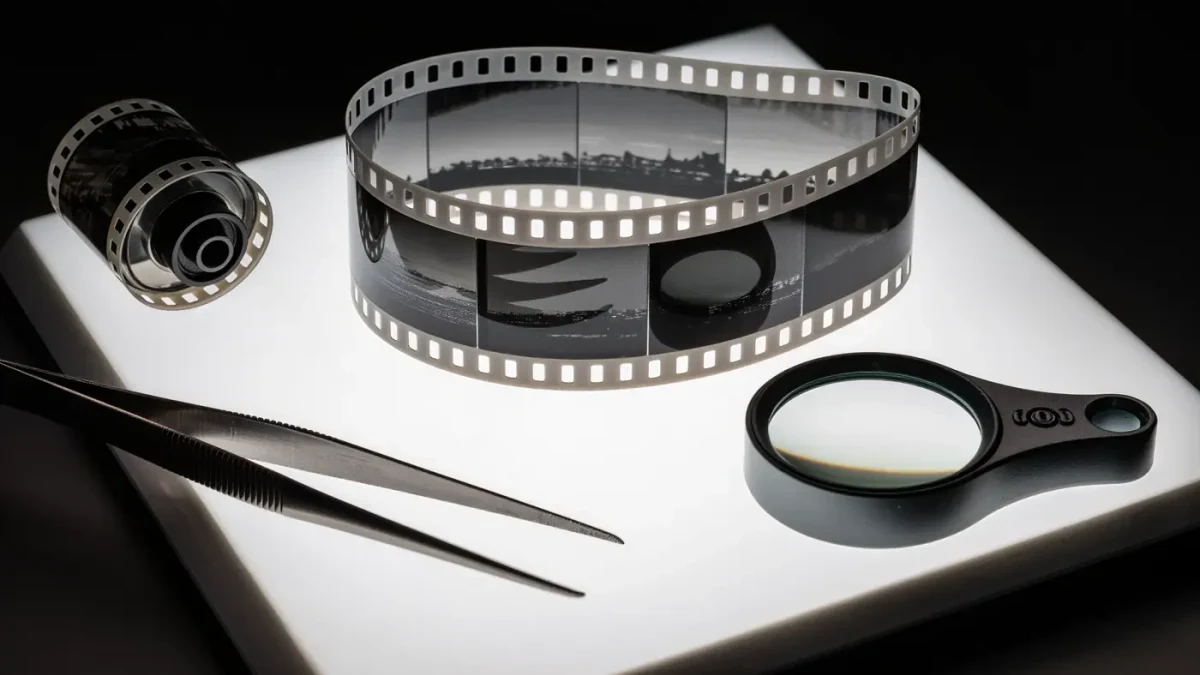
Ilford Delta 3200 is the fastest black and white film in current production: a true sensitivity of ISO 1000/31° that Ilford's datasheet rates for box-speed EI 3200 shooting, grain like weather, and a license to photograph places film has no business working. It runs roughly $13-16 a roll as of 2025 at US retailers.
How fast is it really? The box-speed question
Start with the honest number. Ilford's own datasheet gives Delta 3200 a true speed of ISO 1000/31° in standard developer, with the 3200 box rating working because the film's curve is engineered to stay printable when exposed two-thirds beyond that. In practice this means EI 3200 delivers exactly what most people want — usable negatives of very dark scenes — while anyone chasing maximum quality can rate it 1600 or 1250 and reap finer grain with headroom to spare.
This is not a scandal; it is disclosed engineering, common to ultra-high-speed emulsions for decades. What matters on location: the film does what the box promises in deep shade, dim interiors, and night streets, which is why it owns the low-light slot in nearly every published film guide of the past twenty years.
| Spec | Value |
|---|---|
| Box speed | EI 3200/36° |
| True speed | ISO 1000/31° (Ilford datasheet) |
| Process | Standard black and white chemistry |
| Push ceiling | EI 12500 in Ilford's development chart |
| Rough price | $13-16 per 36 exposures, as of 2025 |
What does the grain actually do?
It dominates, and proudly. At box speed the grain is visible at print sizes where ISO 400 films look smooth; by 8x10 it is texture, by 11x14 it is structure. Sharpness holds up better than the grain suggests — Delta 3200 is a core-shell tabular emulsion, so edges stay defined inside the crunch — but nobody buys this stock for enlargements of blank skies.
Tonality runs compressed in the classic high-speed way: snappy mids, shadows that arrive quickly, highlights that cling. Portraits gain weathered, documentary gravitas; neon and streetlights smear into attractive glow; fog and rain turn photographic. The look has been used by a generation of night shooters precisely because it feels like memory of the dark rather than description of it.
Print size rewards commitment. Small prints read as vintage documentary texture; 8x10 and beyond read as intentional roughness, closer to lithograph than photograph. The film rewards scenes with structure — weathered faces, brickwork, bare branches — and punishes smooth blank expanses, which show grain as static rather than style.
Where does it earn its keep?
Anywhere the shutter speed matters more than the negative's manners. Dim venues and concerts, candlelit interiors, night markets, winter dusk, subways, dim apartments — every situation where an ISO 400 film forces a tripod or a prayer. Because Ilford publishes development times across a huge EI range, you can also rate it 1600 for evening walkaround work and get close to HP5 quality with a stop in hand.
Development deserves a sentence of respect: developer choice visibly changes this film, more than most. Standard developers push grain forward; fine-grain developers tame it at some speed cost. The Massive Dev Chart carries dozens of published combinations, and picking one deliberately is half the craft of shooting this emulsion.
Weather is an ally, oddly. Rain slicks the streets into mirrors that double every light source, fog diffuses the harshest contrast, and snow reflects sky into shadowed corners — conditions that ruin slower films become scenery. Winter cities at night are practically a Delta 3200 genre of their own at this point.
Related stories: Kodak Portra 800 in Low Light · Kodak Ektar 100: Max Color.
How far can you push it?
Ilford's own development chart runs to EI 12500 — yes, twelve thousand five hundred — and labs report usable if heroic results up there. Each stop past 3200 trades shadow detail and adds contrast; the film's core-shell design keeps it from dissolving into mush sooner than physics demands. For sustained low-light work, though, honest exposure at 1600-3200 beats bracketing your way up the EI ladder.
What gear pairs well with it?
Fast glass first. The film exists to convert light starvation into shutter speed, so an f/1.4 or f/2 prime multiplies its advantage — a 50mm at f/1.4 turns candlelight into handheld territory. Manual-focus bodies reward the choice too: autofocus systems hunt in the dark that this film resolves, and zone-focus rangefinders keep working when screens go black.
Meters deserve suspicion at these light levels. Camera meters drift, and shadows that read fine through a viewfinder often sit a stop lower than indicated; handheld spot meters or phone metering apps with a known bias give repeatable results. Because the film's price forgives experimentation, calibration is cheap — shoot a gray card at dusk once and learn what your meter actually does.
What mistakes should you avoid?
The big one: habitual underexposure rescued by pushing. Delta 3200 makes the trap tempting because the push ceiling is real, but negatives consistently metered a stop low and pushed develop harsh contrast and hollow shadows. Meter honestly at the rating you chose, and reserve pushes for genuinely black rooms rather than as a lifestyle.
Second: expecting 400-film tonality. Grain is not a side effect here; it is the product. Shooting the film and then fighting the texture in scanning or printing produces the worst of both worlds. Commit to the look — print bold, scan tall, let the crunch carry the mood.
Third: ignoring development as a creative variable. With published times spanning a wide EI range, the developer choice changes grain, speed, and contrast more than most films; settling on one combination and learning it beats sampling a dozen.
Who should shoot it?
- Concert and venue shooters: the standard answer when stages are lit for eyes, not film.
- Night street photographers: handheld after midnight, with grain as part of the statement.
- Available-light documentarians: interiors, services, bars, homes — anywhere flash would change the scene.
- Skip it if you want smooth tonality, big enlargements, or daylight versatility; a 400-speed film beats it on all three for less money.
The verdict: Ilford Delta 3200 is a tool with one job — making photographs in light that should be too low — and it does that job better than anything else in current production. Pair it with a fast lens, meter for the shadows, and embrace the crunch. For a sense of how far low-light imaging on silver can be pushed, Harvard's Center for Astrophysics spent a century pushing glass plates to record the night sky — the Center for Astrophysics collections tell that story. Delta 3200 is that tradition's handheld descendant — the same appetite for darkness, engineered for coat pockets instead of observatories and priced for ordinary shooters.